Architectural Jewels: Famous Historical Places in Pakistan
Here is the revised, SEO-optimized version of the article. I have shortened the sentences, replaced complex vocabulary with accessible language, added plenty of transition words, and switched passive phrasing into the active voice to meet all the Yoast SEO Premium guidelines.
The Story of Pakistan: From Ancient Lands to Modern Nation
The Ancient Roots: Cradle of Civilization (2500 BCE – 1500 BCE)
Long before modern borders existed, the land of Pakistan hosted one of the world’s earliest urban cultures. This was the famous Indus Valley Civilization.
Mohenjo-daro in Sindh and Harappa in Punjab served as the main centers of this ancient society. First, these people built highly advanced cities with excellent drainage systems. Next, they created wide trade networks across the region. However, this culture eventually declined. Afterward, the region welcomed many new cultures:
- The Gandhara Era: The area became a major center for Buddhist learning. Specifically, the ancient university city of Taxila attracted scholars from all over the world.
- Foreign Conquerors: Later, the Persian Empire integrated these lands. Then, Alexander the Great invaded the region in 326 BCE, followed by the powerful Maurya and Kushan rulers.
The Advent of Islam (711 CE – 1857 CE)
The history of the region changed forever in 711 CE. During this year, a young Arab general named Muhammad bin Qasim conquered Sindh. Because of this victory, people still call Sindh the “Gateway of Islam.”
Consequently, various Muslim dynasties ruled the subcontinent for the next thousand years:
- The Delhi Sultanate: Central Asian kings established strong governments. In doing so, they introduced Islamic art, law, and architecture to the local people.
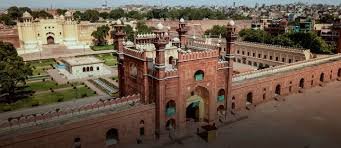
- The Mughal Empire: Emperors like Akbar and Shah Jahan brought a golden age. For instance, they built stunning monuments like the Lahore Fort. During this glorious time, local languages mixed with Persian and Arabic. As a result, the Urdu language was born.
British Rule and the Road to Partition (1857 – 1947)
The British Crown took direct control of India in 1857. Consequently, Muslims lost their political power, which caused widespread economic hardship.
Therefore, Muslim leaders started a massive political awakening:
- The Aligarh Movement: Sir Syed Ahmed Khan pushed for modern education to help Muslims succeed.
- The Two-Nation Theory: In 1930, the famous poet Allama Muhammad Iqbal envisioned a separate, independent homeland for Muslims.
- The Pakistan Resolution: Finally, Muhammad Ali Jinnah led the All-India Muslim League to demand a separate country on March 23, 1940.
Birth of a Nation and Early Struggles (1947 – 1958)
On August 14, 1947, Pakistan officially joined the global map. Initially, the new country had two separate parts: West Pakistan and East Pakistan.
Unfortunately, independence triggered the largest mass migration in human history. Millions of refugees faced terrible violence during their journey. To make matters worse, Pakistan lost its founding father, Jinnah, in September 1948. Therefore, the young nation had to face severe economic challenges without its main leader.
Decades of Change and Conflict (1958 – 1999)
For the next few decades, Pakistan swung between military rule and democracy:
- The Military Eras: General Ayub Khan took power in 1958 and boosted factories. Later, General Zia-ul-Haq introduced strict religious laws across the country.
- The 1971 Separation: Political tensions grew between the two halves of the country. Sadly, a painful civil war caused East Pakistan to break away and become Bangladesh.
- Democratic Rebounds: Zulfikar Ali Bhutto created the nation’s landmark 1973 Constitution. In addition, the 1990s saw intense political rivalry between Nawaz Sharif and Benazir Bhutto, who was the first female Prime Minister in the Muslim world.
- The Nuclear Age: In May 1998, Pakistan successfully tested its nuclear weapons. Thus, it became the seventh nuclear power in the world.
The Modern Era: 21st Century and Beyond
General Pervez Musharraf took control in 1999. Soon after, the 9/11 attacks forced Pakistan to join the global war on terror. This caused a decade of intense violence and economic strain.
However, the country soon made major progress:
- Democratic Transitions: In 2013, one civilian government successfully handed power to another for the first time.
- New Alliances: The country launched the China-Pakistan Economic Corridor (CPEC) to modernize its roads and energy. Furthermore, the election of cricketer-turned-politician Imran Khan disrupted traditional politics in 2018.
Today, Pakistan navigates economic trials and climate change. Yet, it stands proud as a resilient nation of over 240 million people.
Famous Historical Places in Pakistan
Pakistan’s rich history has left behind incredible historical monuments. Here are the most famous places you can visit today:
1. Mohenjo-daro (Sindh)
This ancient city dates back to 2500 BCE. Experts consider it one of the most advanced settlements of the ancient world. Visitors can still see the famous Great Bath and a highly complex brick drainage system.
2. The Ruins of Taxila (Punjab)
Located near Islamabad, Taxila was once the world’s top center for Buddhist education. Today, travelers explore ancient monasteries, stone statues, and the grand Dharmarajika Stupa.
3. The Badshahi Mosque & Lahore Fort (Punjab)
These two side-by-side landmarks represent the peak of Mughal art:
- The Lahore Fort: This massive palace holds the stunning Sheesh Mahal (Palace of Mirrors), which features thousands of tiny glass mosaics.
- The Badshahi Mosque: Built in 1673, this red-sandstone mosque holds over 100,000 worshippers in its courtyard.
4. Rohtas Fort (Jhelum, Punjab)
The Afghan king Sher Shah Suri built this giant fort in the 1541. He wanted to block the return of the Mughal army. The fort has four kilometers of thick stone walls and 68 defensive towers.
5. Shalimar Gardens (Lahore, Punjab)
Emperor Shah Jahan created this beautiful three-tiered paradise garden in 1642. The layout features 410 fountains that still run on an ancient engineering system.
6. Makli Necropolis (Thatta, Sindh)
Makli is one of the largest burial grounds on Earth. It holds up to one million tombs. Kings, queens, and holy saints rest here in sandstone tombs that feature beautiful geometric carvings.